(Installation View, pp. 101–116)
Australian photography in nineteenth century, and particularly those included in intercolonial and international exhibitions, focused on prospective visions of colonial development. In the first half of the twentieth century, the promotion of primary industries continued to take centre stage, but a more sophisticated image of Australia was also under construction. Thus, although the 1936 Empire Exhibition in Johannesburg featured seventy merino fleeces, the walls were also ‘lined with artistic photographs of Australia at work and play’.1 The following year, in the less commercial Exposition Internationale des Arts et Techniques dans la Vie Moderne (International Exhibition of Arts and Crafts in Modern Life) in Paris, even more effort was made to showcase Australia’s intellectual life. The Australian Government, although initially reluctant to participate, came to see the 1937 event as an opportunity to ‘dispel European ignorance of Australia’ and ‘remove the idea that Australians lack culture’.2
Held inside a strikingly modern, cylindrical building designed by architects Sir Arthur George Stephenson, Percy Hayman Meldrum and Donald Turner – and with Sydney Ure Smith, editor of Art in Australia, on the advisory committee – Australia’s exhibition included an extensive arrangement of Australian paintings, drawing and etchings. It also included a separate display of Aboriginal artefacts and designs, and large photographic murals produced with the involvement of advertising photographer Russell Roberts in conjunction with the Australian National Travel Association (who had begun to publish the photographic travel magazine Walkabout in 1934). Those ‘very large and very beautiful photographs’, as one reviewer described them, included aerial city views, surfers, the university in Perth, as well as gumtrees, cattle, a stockman, a kangaroo and a koala, and a ‘proud’ Aboriginal man. That man was Gwoya Tjungurrayi, a Walpiri-Anmatyerre man of the Northern Territory, also known by his nickname One Pound Jimmy. His striking portrait was made by photographer Roy Dunstan in 1935, and had been used as used as the cover of Walkabout magazine in September 1936, drawing considerable response.3 The Sydney Morning Herald wrote that ‘the frieze of photographs portraying typical Australian scenes is notably fine … the most impressive pictorial advertisement the Exhibition has to show’. The reviewer compared them favourably to Australia’s ‘immeasurably dull canvases’ – largely pastoral landscape scenes – which in his view were ‘far more photographic than the photographs, and much less strikingly impressive’.4 The Republican Spanish pavilion debuted Picasso’s Guernica at the same event.5
Roberts was also given overall responsibility for the photography in the Australian Pavilion at the 1939 New York World’s Fair. Such an exhibition, design director Douglas Annand argued, was ‘essentially a tableau of national life – a display in which national character, the nature of a country, its life and industry, are dramatised into an exciting and informative spectacle’.6 Towards this end, Annand harnessed modern art and design across a flowing multi-level space that integrated sculpturally designed display cases with murals and displays devoted to wool, industry and travel. Alongside art by Margaret Preston and Adrian Feint, photographs of sheep still dominated, however the images were now closely cropped, presented as handcoloured photomontages, backlit in illuminated three-dimensional modular display cases (known as ‘russlites’) to represent a dynamic and modern nation, supplemented by depictions of the machines that transform wool into various products, as well as images of electricity pylons.7 The exhibition also included photographs by Dahl and Geoffrey Collings, clearly influenced by the European New Vision photography, and Max Dupain’s large aerial view of Sydney Harbour.
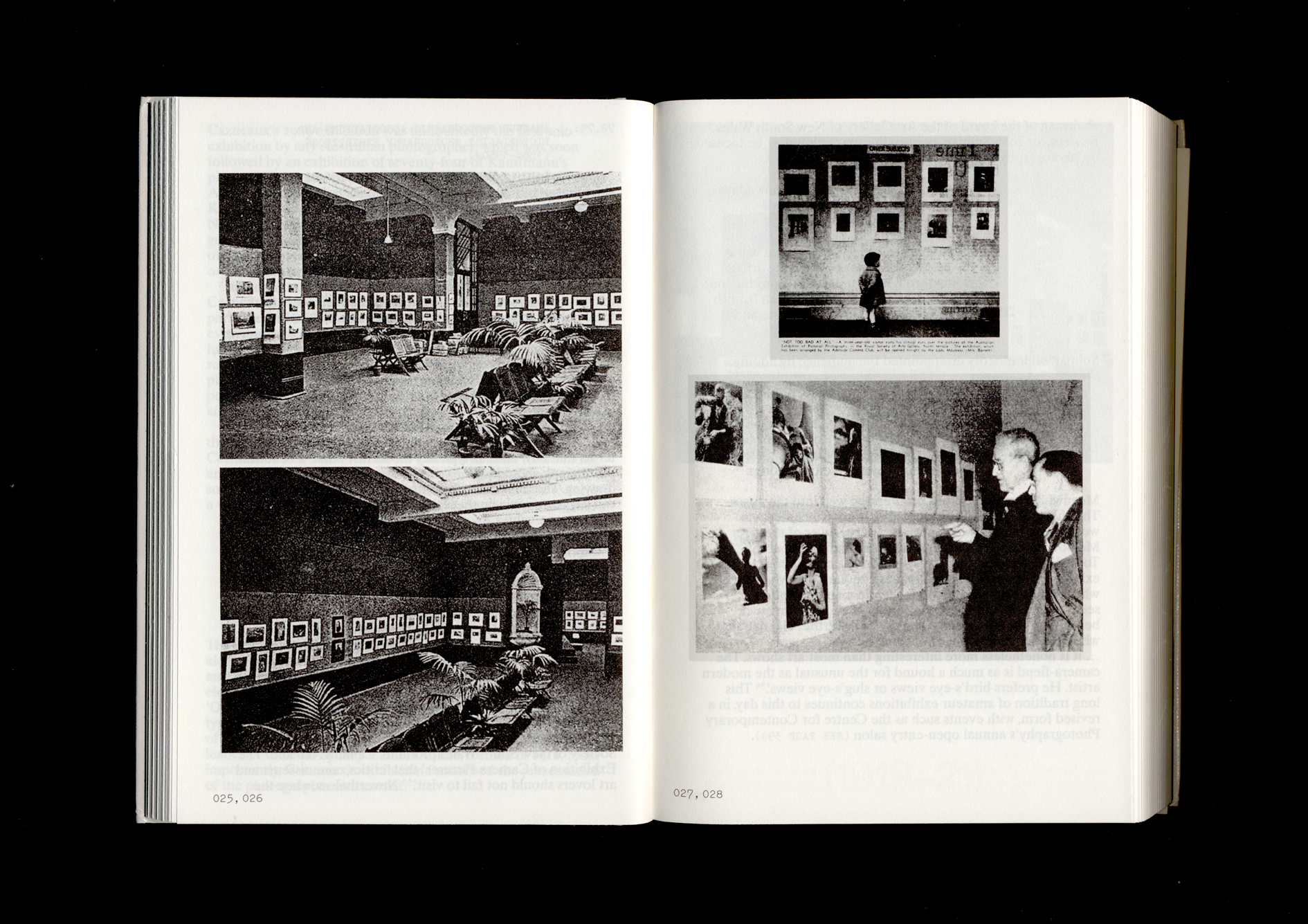
In 1938, a major Commemorative Salon of Photography exhibition was held in Sydney as part of Australia’s 150th anniversary celebrations. Organised by the Photographic Society of New South Wales, in association with the Sydney Camera Circle and the Professional Photographers Association of New South Wales, the exhibition was staged in the basement of the Commonwealth Bank Building, and included photographers from thirty-two countries who sent 1600 prints, of which 622 were on display, including landscapes, portraits, aerial pictures and photomicrographs. According to a review in the Sydney Morning Herald, there was ‘a notable absence from this exhibition of the ultra-artistic brush printing’.8
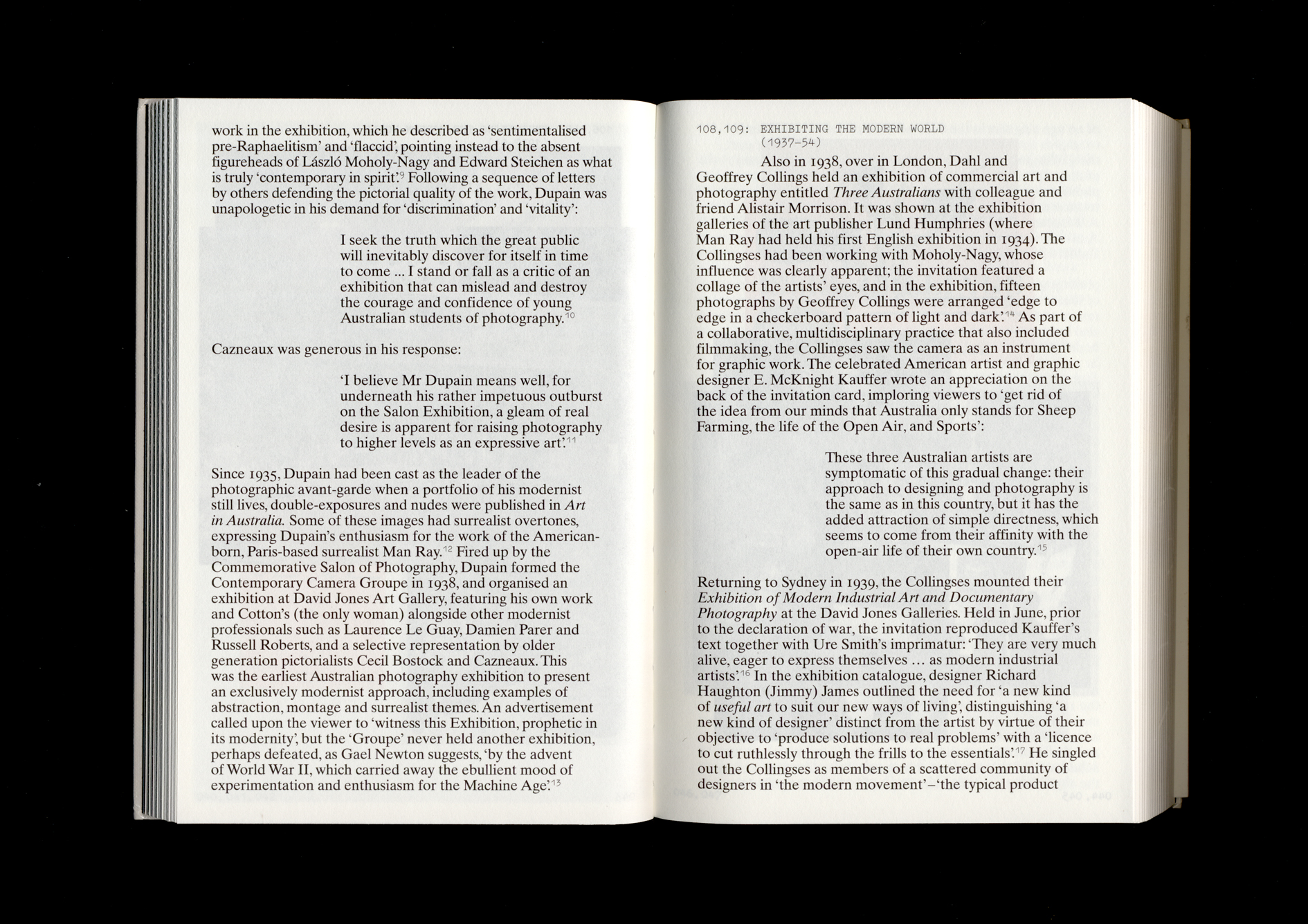
Despite its inclusion of his soon-to-be wife, Olive Cotton, Dupain used the exhibition to engage in a very public debate about photography. In response to a gushing piece by the judge, Harold Cazneaux, in the Sydney Morning Herald, Dupain took particular issue with the selection of European work in the exhibition, which he described as ‘sentimentalised pre-Raphaelitism’ and ‘flaccid’, pointing instead to the absent figureheads of László Moholy-Nagy and Edward Steichen as what is truly ‘contemporary in spirit’.9 Following a sequence of letters by others defending the pictorial quality of the work, Dupain was unapologetic in his demand for ‘discrimination’ and ‘vitality’:
I seek the truth which the great public will inevitably discover for itself in time to come … I stand or fall as a critic of an exhibition that can mislead and destroy the courage and confidence of young Australian students of photography.10
Cazneaux was generous in his response: ‘I believe Mr Dupain means well, for underneath his rather impetuous outburst on the Salon Exhibition, a gleam of real desire is apparent for raising photography to higher levels as an expressive art’.11
Since 1935, Dupain had been cast as the leader of the photographic avant-garde when a portfolio of his modernist still lives, double-exposures and nudes were published in Art in Australia. Some of these images had surrealist overtones, expressing Dupain’s enthusiasm for the work of the American-born, Paris-based surrealist Man Ray.12 Fired up by the Commemorative Salon of Photography, Dupain formed the Contemporary Camera Groupe in 1938, and organised an exhibition at David Jones Art Gallery, featuring his own work and Cotton’s (the only woman) alongside other modernist professionals such as Laurence Le Guay, Damien Parer and Russell Roberts, and a selective representation by older generation pictorialists Cecil Bostock and Cazneaux. This was the earliest Australian photography exhibition to present an exclusively modernist approach, including examples of abstraction, montage and surrealist themes. An advertisement called upon the viewer to ‘Witness this Exhibition, prophetic in its modernity’, but the ‘Groupe’ never held another exhibition, perhaps defeated, as Gael Newton notes, ‘by the advent of World War II, which carried away the ebullient mood of experimentation and enthusiasm for the Machine Age’.13
Also in 1938, over in London, Dahl and Geoffrey Collings held an exhibition of commercial art and photography entitled Three Australians with colleague and friend Alistair Morrison. It was shown at the exhibition galleries of the art publisher Lund Humphries (where Man Ray had held his first English exhibition in 1934). The Collingses had been working with Moholy-Nagy, whose influence was clearly apparent; the invitation featured a collage of the artists’ eyes, and in the exhibition fifteen photographs by Geoffrey Collings were arranged ‘edge to edge in a checkerboard pattern of light and dark’.14 As part of a collaborative, multidisciplinary practice that also included filmmaking, the Collingses saw the camera as an instrument for graphic work. The celebrated American artist and graphic designer E. McKnight Kauffer wrote an appreciation on the back of the invitation card, imploring viewers to ‘get rid of the idea from our minds that Australia only stands for Sheep Farming, the life of the Open Air, and Sports’:
These three Australian artists are symptomatic of this gradual change: their approach to designing and photography is the same as in this country, but it has the added attraction of simple directness, which seems to come from their affinity with the open-air life of their own country.15
Returning to Sydney in 1939, the Collingses mounted their Exhibition of Modern Industrial Art and Documentary Photography at the David Jones Galleries. Held in June, prior to the declaration of war, the invitation reproduced Kauffer’s text together with Ure Smith’s imprimatur: ‘They are very much alive, eager to express themselves … as modern industrial artists’.[^16] In the exhibition catalogue, designer Richard Haughton (Jimmy) James outlined the need for ‘a new kind of useful art to suit our new ways of living’, distinguishing ‘a new kind of designer’ distinct from the artist by virtue of their objective to ‘produce solutions to real problems’ with a ‘licence to cut ruthlessly through the frills to the essentials’.16 He singled out the Collingses as members of scattered community of designers in ‘the modern movement’ – ‘the typical product of an age singular in the ease with which information and examples circulate around the civilised globe’. For their part, the Collingses included a short manifesto on documentary photography: ‘Sharp definition alone will not make a truthful photograph. We are dealing with life, in which an exhaustive treatise carries less power of conviction than an epigram. A documentary photograph is an epigram in picture form’.17 A review in the Sydney Morning Herald titled ‘Interesting Exhibition’ described the ‘vigorously stimulating work’.18
International modernism influenced Australian photography exhibitions via various routes. With the onset of World War II, not only did Australians based in Europe return to Australia, but the need for government propaganda also led to several young photographers with international horizons becoming official photographers in the war zones. In 1944, the Department of Information toured Australia Fights, an exhibition of official photographs taken on the front lines of New Guinea and North Africa. In the same year, the Allied Works Council toured an exhibition of 500 photographs documenting the work of the Civil Construction Corps, a civilian ‘army’ conscripted to build vital war infrastructure. Edward Cranstone, the photographer working for the Allied Works Council, was a member of the Australian Communist Party and was strongly influenced by the propaganda photographs regularly sent from Soviet Union and published in the Communist newspaper the Tribune.19 He shot Australian workers in the same Soviet style – from a low angle, against a bold sky, with dynamic diagonals, and enlarged them up to 1.5 x 2.0 metres. Their extreme stylisation was not to all tastes; when the exhibition was installed at Parliament House in Canberra, the Speaker of the House of Representatives complained that a photograph of an excavation scene looked like Dartmoor Prison.20 Over eighty thousand people saw the exhibition as it toured every capital city, showing at a state galleries, city halls or shopping centres.
Ure Smith’s The Home magazine (1920–42) was the chief organ for stylish advertising photography during the 1920s and 30s, promoting a modern lifestyle to the monied classes. Photographers were also exposed to modern advertising styles rapidly developing in the United Kingdom and the United States through professional journals such as Modern Publicity, distributed in Australia by Ure Smith. At the 1938 Chemical Industries Exposition in Sydney, Kodak advertised its ‘Functional Photography’ with banks of enlarged micrographs of insects, aerial views, an army parade and, as in the 1939 New York World’s Fair, backlit transparencies. After the War, publicity enlargements grew even bigger. For instance, the NSW government fought the wartime scourge of venereal disease with a window display in the Queen Victoria Building, where the ‘silent killer’ of venereal disease haunted a life-size photograph of a well-dressed couple. Every Health Week in the early 1950s, they built entire displays from photographic enlargements in the lower Sydney Town Hall, the site of many a pictorialist salon. And when the Queen visited in 1954, the streets were lined with photographic constructions – a ceremonial arch across Bridge Street edifying the Queen and the Duke with giant photographs of a wool auction.
A modern spirit in photography also evolved in Western Australia in the late 1930s. In September 1941, during World War II, Axel Poignant and Hal Missingham held a joint exhibition of photographs at Perth’s Newspaper House, which included fifty images by each photographer, accompanied by a series of conversational lectures promulgating the message that ‘the camera user should develop his power of vision’.21 The photographs presented things, people and places simply and directly with the purpose of arousing interest in the subject. In this hope of direct communication from subject to viewer via the mediation of the photographer’s vision, Poignant and Missingham presented a complementary philosophy of documentary photography to that of the Collingses in Sydney. In the foreword to the exhibition catalogue, ‘New Developments in Photography’, Alec King wrote of photography’s ability to make the viewer see things clearly and freshly as a child, making only a qualified reference to art (‘The man behind the camera we can call an artist if we like.’).22
The following year Poignant began his extensive photographic documentation of the outback and Aboriginal people, travelling the Canning Stock Route. No works from this period were presented publicly until 1947, when two portraits – one of a young Aboriginal mother and baby, and another of a young head stockman – were awarded prizes as part of Australian Photography 1947, a major exhibition staged in Newcastle that also generated a substantial book of the same name published by Oswald Ziegler.23 In the book, Poignant’s Aboriginal mother – which is entitled Mary, making overt reference to the Madonna and Child – is the first image as the winner of the Gold Plaque. In the foreword, Missingham (at this point, the newly appointed director of the National Art Gallery of New South Wales) asserted that ‘Photography, like painting, is one aspect of visual art’, and went on to argue that it had its own aesthetic:
The first consideration in the selection of prints … has been directed pointedly towards those photographs that unmistakably pronounce themselves as PHOTOGRAPHS; that are not imitative of other graphic methods. As an artist I feel this to be of the greatest importance. … It is interesting to notice in photography the parallels that exist in painting; to compare the romantic and diffuse subject matter of early Australian work with the present awakening interest in the harder and perhaps more factual aspects of our immense land; with their searching after character and texture, attention has been focused on the unaccountable details which in their sum total make a new but unmistakeable vision of our country.24
Thus, by 1947, Australian photography was self-consciously modern, and its leading practitioners understood themselves as artists. And yet, as Cazneaux bemoaned in the same publication, Australian art galleries still failed to recognise their work: ‘If we visit our national art galleries we can study the pictures of the artists of the past and present, but where will we go to study the work of the past and present masters in pictorial photography?’25
-
‘Empire Exhibition: Australian Display in South Africa’, The Age, 3 August 1936, p. 12. ↩
-
Memorandum quoted in Carolyn Barnes and Simon Jackson, ‘20. A significant mirror of progress: Modernist Design and Australian Participation at Expo 67 and Expo 70’, in Kate Darian-Smith (ed.), Seize the Day: Exhibitions, Australia and the World, Monash University Press, Melbourne, 2008. Online at: http://books.publishing.monash.edu/apps/bookworm/view/SEIZE+THE+DAY/123/xhtml/chapter20.html. Accessed 22 October 2019. ↩
-
Tjungurrayi later became the first Aboriginal person to be featured on an Australian postage stamp. Dunstan’s image was used as the basis for the image on an 8½ pence stamp in 1950. ↩
-
Denzil Batchelor, ‘Paris Exhibition: Australian Pavillion – Interesting Display’, The Sydney Morning Herald, 18 September 1938, p. 16. ↩
-
Catherine De Lorenzo, unpublished lecture at the Art Association of Australia and New Zealand conference, December 2018. ↩
-
Annand in Art in Australia, 1939, quoted in: Barnes and Jackson, ‘20. A significant mirror of progress’. ↩
-
See: Ann Stephen and Philip Goad, ‘Good Evening America: Australia’s Pavilion Democracy’, in Ann Stephen et al (eds.), Modern Times: The Untold Story of Modernism in Australia, Miegunyah Press, Melbourne, 2008, p, 181. ↩
-
Sydney Morning Herald, 24 March 1938, p. 8. ↩
-
Sydney Morning Herald, 30 March 1938, p. 12. ↩
-
Sydney Morning Herald, 7 April 1938, p. 6. ↩
-
Sydney Morning Herald, 8 April 1938, p. 8. ↩
-
Two months earlier Dupain had published a glowing review of Man Ray’s 1934 monograph in The Home magazine. See: Max Dupain, ‘Man: His Place In’, The Home, Sydney, 1 October 1935, p. 38. ↩
-
See: Gael Newton, Max Dupain, David Ell Press, 1980, online at https://www.photo-web.com.au/dupain/maxdupain/02.html. Accessed 22 October 2019. See also Helen Ennis, Olive Cotton, 4th Estate, HarperCollins, Sydney, 2019. ↩
-
See: Isobel Crombie, ‘A Documentary Impulse: Australian Photographer Geoffrey Collings’, Art Bulletin of Victoria, vol. 29, 1989, pp. 38–51. ↩
-
Invitation to Three Australians: Dahl and Geoffrey Collings and Alistair Morrison at Lund Humphries Gallery, London, 1938, in the collection of the Museum of Applied Art and Sciences, Sydney.
[16]: Invitation to Exhibition of Modern Industrial Art and Documentary Photography, by Dahl and Geoffrey Collings at the David Jones Gallery, 1939, in the collection of the Museum of Applied Art and Sciences, Sydney. ↩ -
Catalogue for Exhibition of Modern Industrial Art and Documentary Photography, David Jones Galleries, Sydney, 1939 in the collection of the Museum of Applied Arts and Sciences, Sydney, n.p. ↩
-
ibid., n.p. ↩
-
‘Dahl and Geoffrey Collings: Interesting Exhibition’, Sydney Morning Herald, 6 June 1939, p. 13. ↩
-
Martyn Jolly, ‘Edward Cranstone, Photographer’, Photofile, Autumn 1984, pp. 1–4. ↩
-
Herald (Melbourne), 20 September 1944, p. 3. ↩
-
After moving to Perth from England in 1930, Poignant gained an interest in photography when he purchased a Leica camera in 1933 and specialised in portrait photography. He also made aerial landscapes and experimented with aerial and low points of view alongside his work as a commercial studio operator. He became friends with the graphic artist and photographer Hal Missingham after he returned to his hometown of Perth in 1940 following fourteen years of study and work in Paris and London. ↩
-
Alec King quoted in Roslyn Poignant, ‘The Photographic Witness?’, Continuum: Journal of Media & Cultural Studies, vol. 6, no. 2, 1993, p. 197. ↩
-
As Gael Newton notes in Shades of Light: Photography and Australia 1839–1988, Australian National Gallery, Canberra, 1988, p. 126: Australian Photography 1947 was ‘the first of a planned annual series covering the best of Australian photography. It was a substantial book with pages of quality illustrations drawn from the works submitted for the accompanying exhibition. It was in the tradition of both the old Pictorial salon catalogues and the newer annuals such as US Camera Annual. Pictorial work was included as well as technical categories but the book validated the importance of the documentary photographers and professional illustrators’. ↩
-
Hal Missingham, Foreword, Australian Photography 1947, Ziegler Gotham Publications, Sydney, 1948, p. 7. ↩
-
Harold Cazneaux, ‘Landscape photography’, Australian Photography 1947, Ziegler Gotham Publications, Sydney, 1948, p. 17. ↩