(Installation View, pp. 179–190)
The 1970s saw the establishment of a raft of independent galleries that specialised in photography. Some harboured commercial ambitions, but most were short-lived ventures run on the energy of photographers themselves. While in the 1960s, photographers such as those in Group M used exhibitions to advocate for photography as art, in the 1970s photographers established galleries themselves – a role that, by the end of the decade, gradually transferred to a new wave of professional photography curators in art museums and galleries. The most notable photography gallery to emerge was the Australian Centre for Photography (ACP), which opened its doors in Sydney in 1974 as a venue for the exhibition, instruction and promotion of the medium. However, Melbourne was the undisputed capital of photography in the 1970s, reflected in the number of galleries devoted to the medium and spurred on the by the establishment of the first state gallery department of photography at the National Gallery of Victoria (NGV) in 1967.
Perhaps the crucial impetus for the surge of interest in photography and photography galleries during the period was institutional funding from the Whitlam Labor government, which had come to power in 1972 and immediately injected funds into the Australia Council and art schools nationwide. In the late 1960s, Australian tertiary educational institutions had started to introduce art photography programs, with the course at Prahran College of Advanced Education, which commenced in 1968, being a notable example. In 1971, the fashion photographer Athol Shmith left commercial practice to lead Prahran’s photography department, teaching with John Cato and the filmmaker Paul Cox. Their support directly inspired a generation of talented students including Bill Henson, Carol Jerrems, Steven Lojewski, Rod McNicol, Christopher Köller and Philip Quirk.
Down the road, in South Yarra, the social and advertising photographer Rennie Ellis turned a former commercial gallery known as Brummels Gallery into the first Australian gallery dedicated to photography in 1972. At the time, it was probably among only a small group of such venues worldwide. Located on the top floor of 95 Toorak Road, South Yarra, above Brummels espresso bar, it was essentially an ‘artist-run’ space for photography, and reflected a moment in which the impact of counter-culture politics and feminism brought a new range of personal subject matter to the fore. Ellis and his cousin Robert Ashton – the gallery’s assistant director – were passionately dedicated to providing a platform for photography to be redefined as fine art, and to providing an opportunity for photographers to exhibit their creative work without commercial restraints: ‘pure non-applied photography where the photographer has had no restrictions imposed on him save those he initiates himself’, wrote Ellis in 1972.1 Established commercial photographers embraced the opportunity to exhibit photographs of a personal and experimental nature, while a new generation of art students provided emerging talent. This dynamic was evident in the provocative opening show, Two Views of Erotica: Henry Talbot/Carol Jerrems, launched on 14 December 1972 by photographer and filmmaker Paul Cox, who would also later be part of the Photographers’ Gallery around the corner. Talbot was fifty-two, Jerrems only twenty-three.
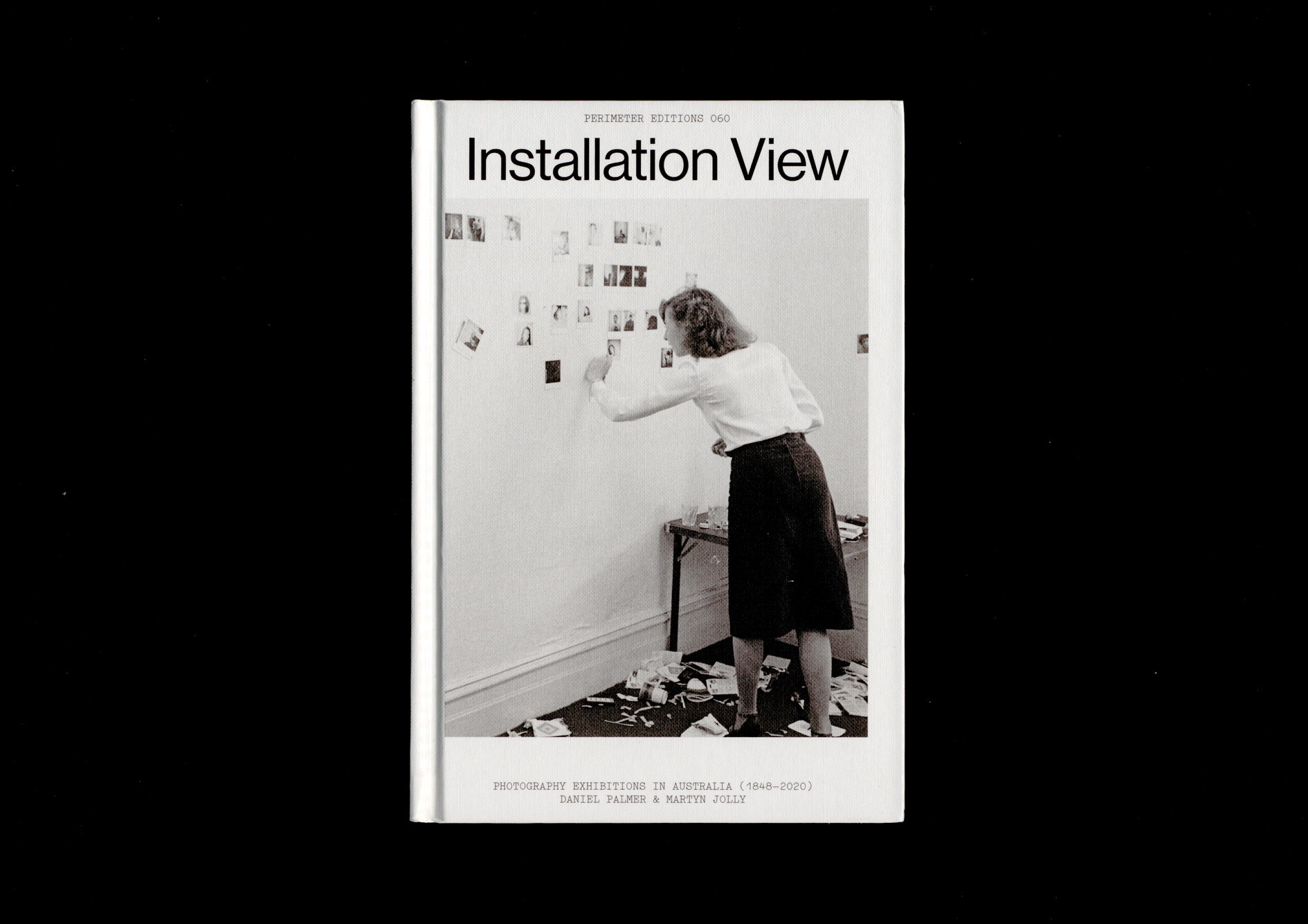
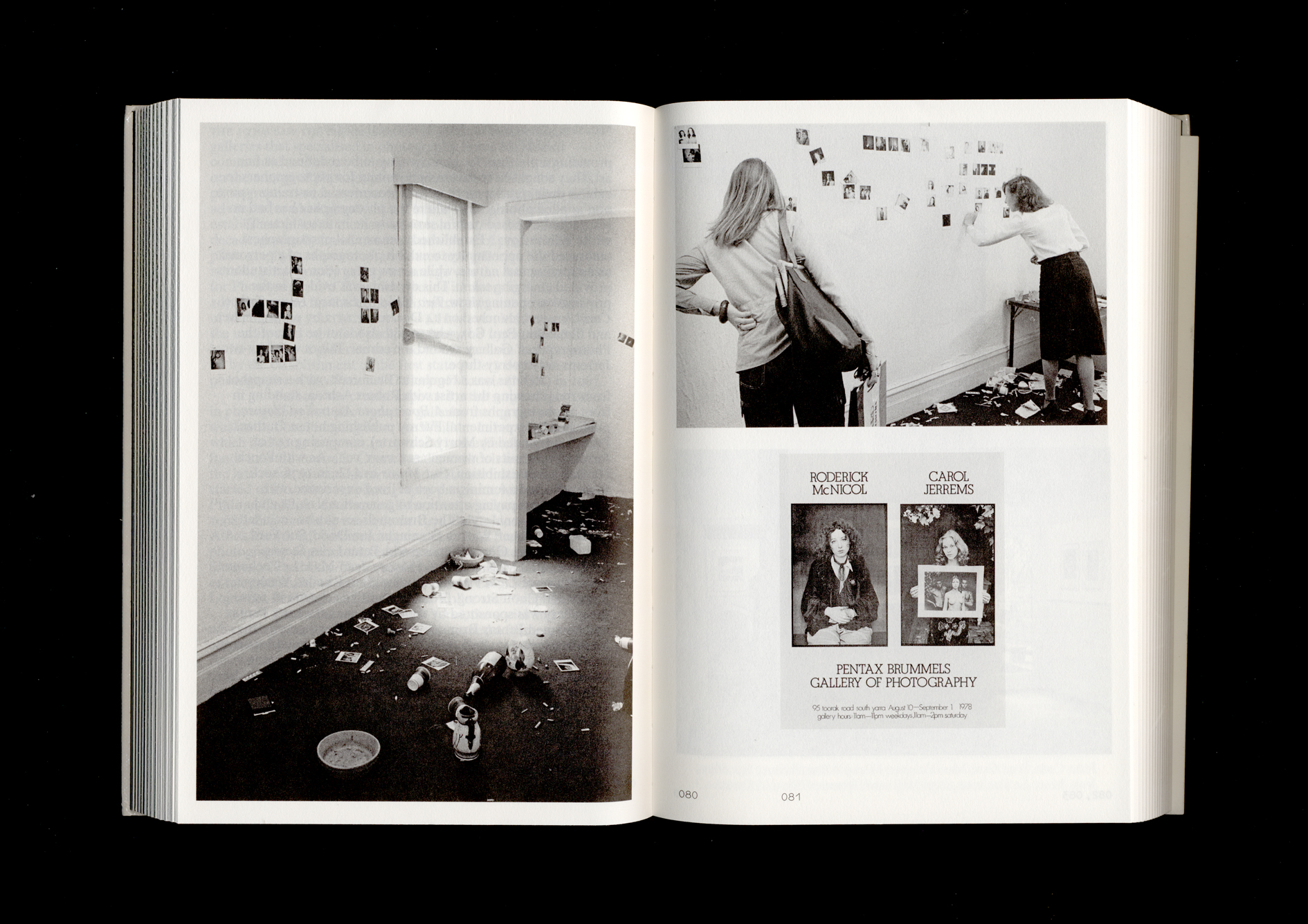
Jerrems was a regular at Brummels, with a snapshot from 1974 showing the artist with Robert Ashton, standing in front of photographs from A Book about Australian Women, a compendium published by experimental Fitzroy publishing house Outback Press (co-founded by Morrie Schwartz), comprising 131 of Jerrems’ portraits of women. As with Ponch Hawkes’ first exhibition, Our Mums and Us, in 1976, such work reflected a feminism born of lived experience, with photographers paying attention to generational shifts and aspects of personal style. The Brummels scene also included Godwin Bradbeer, Warren Breninger, Ian Dodd, Sue Ford, George Gittoes, Gerard Groeneveld, Peter Leiss, Steven Lojewski, Rod McNicol, David Moore, Jean-Marc Le Pechoux (also editor of Light Vision magazine), Jon Rhodes, Wesley Stacey and Geoff Strong. From 1977 until its closure in 1980, the gallery was sponsored by the camera manufacturer Pentax and renamed Pentax Brummels Gallery of Photography. In total, between 1972 and 1980, Brummels staged around seventy exhibitions, with early installation documentation showing one space with dark walls, seagrass matting and ashtrays in the corner, and another with light walls near a Victorian window. One of the most unusual exhibitions, Debris of Surprise, an event-based exhibition-cum-artwork created by Rennie Ellis in December 1977, speaks volumes about the scene. The walls were initially bare and people at the opening were supplied with Polaroid cameras and encouraged to document the gathering; the resulting snapshots, along with the debris of the evening’s party (empty bottles, dirty glasses, overflowing ashtrays) were left on display for the duration of the exhibition.2
Not far from Brummels, at 344 Punt Road, South Yarra, The Photographers’ Gallery was established in 1973 by photographers Rod McNicol, Paul Cox, John Williams and Ingeborg Tyssen, and then passed on to Ian Lobb and William (Bill) Heimerman, who ran it as a duo for a few years before Heimerman went on to run it alone. Known as the Photographers’ Gallery and Workshop from 1975 onwards, the gallery presented a raft of Australian and international photographs, and hosted workshops taught by photographers including John Cato, William Clift, Ralph Gibson, Ian Lobb, Steven Lojewski and Les Walkling.3 A photograph from 1978 shows Heimerman adjusting Robert Besanko prints in the main space of the gallery, surrounded by neatly matted and glass-framed work in the American modernist tradition. If Brummels was a countercultural scene, The Photographers’ Gallery was the home of the American West Coast ‘fine print’ tradition, which came under increasing attack by feminist critics as patriarchal and conservative.
Also capitalising on the apparent ‘photo-boom’ and seeking to facilitate the acquisition of photographers’ work into public institutions and the Philip Morris Collection (later donated to the National Gallery of Australia, Canberra), Joyce Evans established the Church Street Photographic Centre at the corner of Gipps and Church Streets in the inner-city Melbourne suburb of Richmond. Opened on 10 August 1977 by Jennie Boddington, curator of photography at the National Gallery of Victoria, the gallery ¬–¬ which was stationed in a white Victoria terrace house –presented an ambitious roster of Australian photographers over an intense four-year period, including early exhibitions of Bill Henson and Fiona Hall. But perhaps more notable were Evans’ exhibitions of international photographers, including many Europeans and figures from the history of photography such as Eugène Atget, André Kertész and Henri Cartier-Bresson, as well as Americans Imogen Cunningham, Les Krims, Lee Friedlander and others. Astonishingly, at that moment in time, there were three independent photography galleries within a few kilometres of one another in Melbourne. Reflecting in 2005, Evans describes the opening show, The Australian Eye, as being ‘devoted to outstanding Australian photographers of the like of Mark Strizic, John Cato, Paul Cox, Max Dupain, Micky Allan, Robert Besanko, Jean-Marc Le Pechoux, John Williams, Rennie Ellis and David Moore’, noting that the ‘highest priced items in the exhibition were Dupain’s Sunbather and Meat Queue, both at $208’.4 When the Church Street Photographic Centre closed in December 1981, its bookshop was sold off as The Printed Image on Chapel Street. Meanwhile, in Sydney, the historically oriented Josef Lebovic Gallery opened in 1977 and continues to this day.
Looking back in 1988, Helen Ennis noted:
By the late 1970s it seemed that photography had secured its place in the art world. But in fact, the distinction between ‘photography’ and ‘art’ was still being upheld in most quarters, and there was seldom any interaction between photographers and artists or between venues for photography and other media.5
Nevertheless, Marianne Baillieu’s avant-garde Realities Gallery in Toorak held exhibitions by Strizic, Henson and Grant Mudford in the 1970s. Another important exception to the segregation was found at the George Paton Gallery at the University of Melbourne, which, as an experimental art space, had also become a crucial venue for the exhibition of photography during this period, particularly from 1975 to the early 1980s.6 However, photography here took a different form, under the influence of more conceptual approaches to artmaking and especially in relation to feminism. Artists such as Micky Allan, Virginia Coventry, Christine Godden, Ruth Maddison and Robyn Stacey all held significant early shows of photography there. Notable international exhibitions included Diane Arbus in 1976, John Heartfield in 1982, Victor Burgin in 1988 and Jo Spence in 1990. Tellingly, given the centrality of photography to the George Paton Gallery’s program, several of its directors went on to occupy influential institutional positions in photography: Judy Annear (1980–82) later became curator of photography at the Art Gallery of New South Wales; Denise Robinson (1982–86) became director of the ACP during its ‘postmodern’ heyday (1986–1992); and Stuart Koop (1990) became director of the Centre for Contemporary Photography in Melbourne.
-
‘Brummels Gallery of Photography’, https://www.rennieellis.com.au/rennie-ellis/brummels. Accessed 1 August 2019. ↩
-
As Stephen Zagala notes in the exhibition catalogue essay for Brummels: Australia’s First Gallery of Photography, Monash Gallery of Art, Melbourne, 2011: ‘the exhibition is an early example of what has more recently been described as “relational aesthetics”, where ‘the artwork creates a social environment in which people come together to participate in a shared activity.’ ↩
-
Marcus Bunyan, ‘Vale William Heimerman (1950-2017)’, Artblart, online at: https://artblart.com/2017/10/27/vale-william-heimerman-1950-2017. Accessed 1 September 2019. ↩
-
Joyce Evans, ‘Church St’. In Flash, Centre for Contemporary Photography newsletter, Melbourne, 2005. ↩
-
Helen Ennis, Australian Photography: The 1980s, exhibition catalogue, Australian National Gallery, Canberra, 1988, p. 15. ↩
-
George Paton Gallery (established 1975) occupied a unique position in Melbourne in the 1970s. As Helen Vivian notes, in When You Think About Art: The Ewing and George Paton Galleries, 1971–2008, Macmillan Art Publishing, Melbourne, 2008, p. 18: ‘Until ACCA opened in 1983 followed shortly by Gertrude Street in 1985, it was the first continuous publicly funded experimental art space in Australia, pre-dating Adelaide’s EAF (1974) and Brisbane’s Institute of Modern Art (1975). The Gallery’s main peers during the early 1970s were private galleries such as Pinacotheca in Melbourne and Watters in Sydney … The most like-minded contemporary art spaces were artist-run spaces such as Inhibodress in Sydney (1970–72) and Art Projects in Melbourne (1978).’ ↩