(Installation View, pp. 157–168)
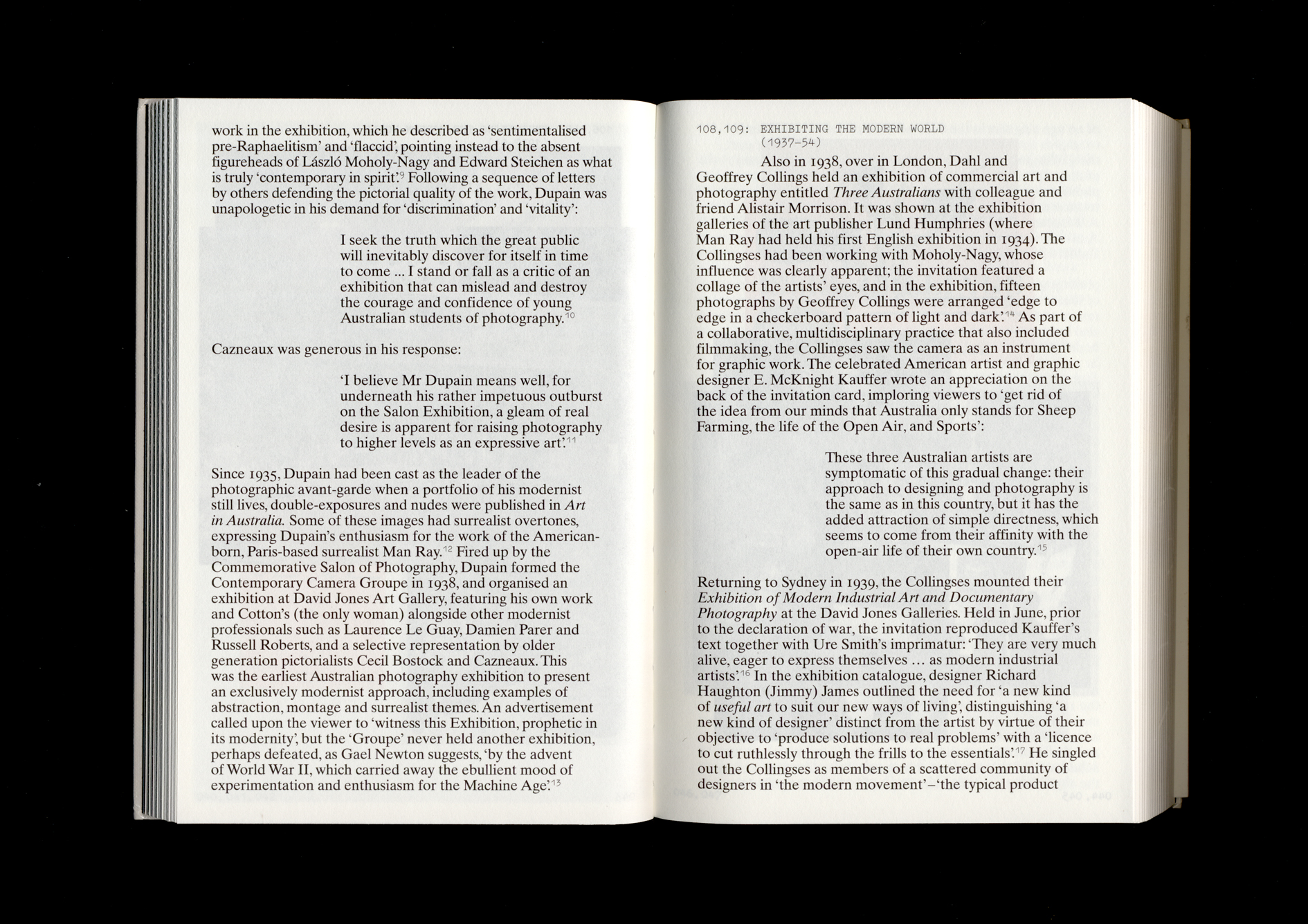
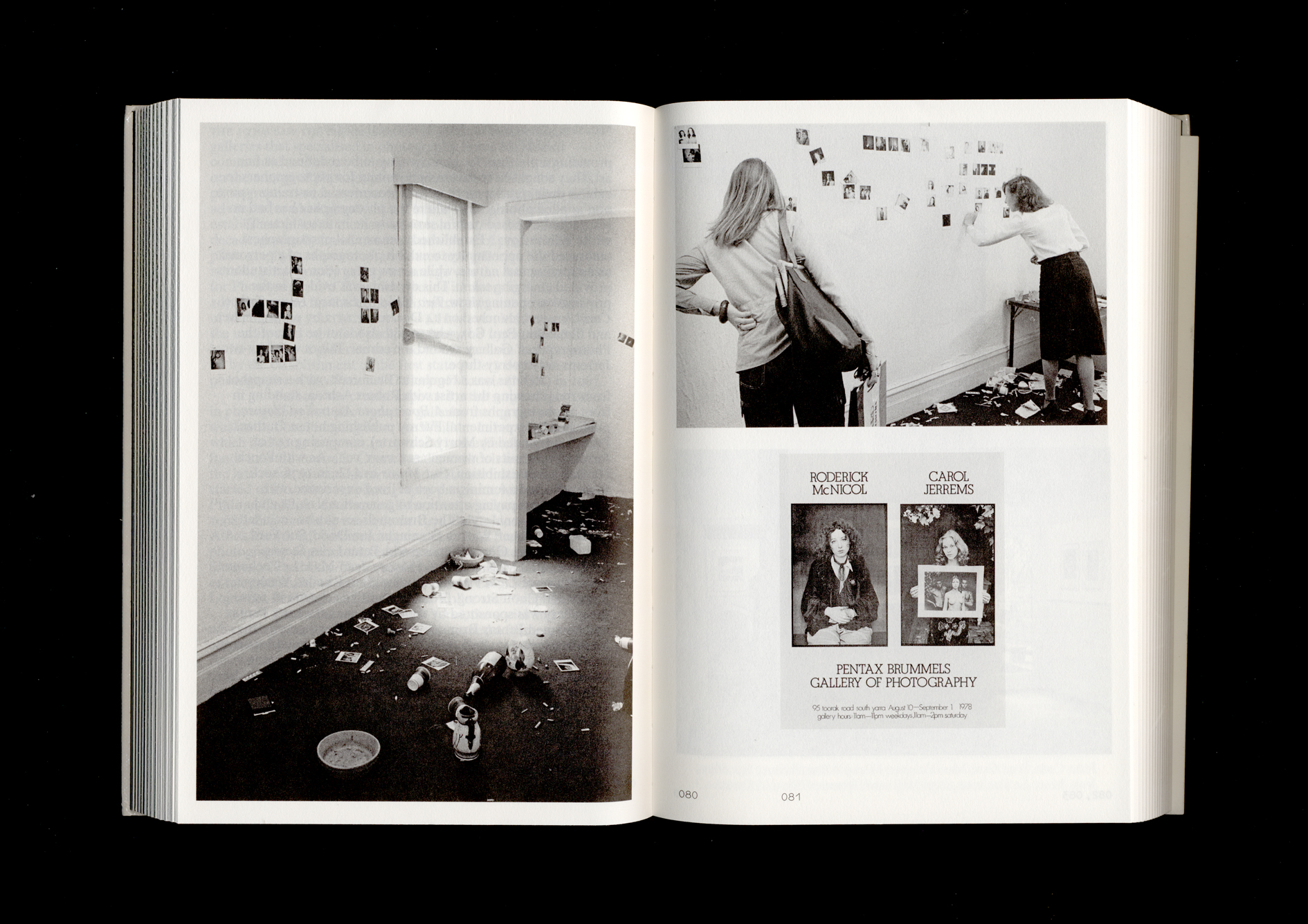
On 8 December 1969, the Chairman of Kodak Australasia opened The Perceptive Eye at the National Gallery of Victoria (NGV). Curated by Albert Brown and NGV director Eric Westbrook, the exhibition featured five Australian photographers – David Beal, David Moore, Helmut Gritscher, Lance Nelson and Richard Woldendorp – although in a sign of post-war migration, only Moore and Nelson were Australian-born. They presented eight prints, all unframed, double-hung along large white panels – a far more restrained design than had been seen in exhibitions by Group M earlier in the 1960s. The black and white photographs depicted elements of everyday Australian life such as people, landscapes and buildings.
The exhibition’s title was a local echo of an international exhibition, The Photographer’s Eye, which had toured from The Museum of Modern Art (MoMA) the year prior. Originally held in New York in 1964, that exhibition was MoMA’s new director of photography John Szarkowski’s defining statement of photography as a modern art medium. The touring version included 150 photographs ‘selected to define the unique characteristics of this art form’, and included snapshots alongside images by famous photographers such as Julia Margaret Cameron, Eugène Atget and Lee Friedlander. The exhibition argued that photography possessed a ‘special visual language’ defined by five characteristics: ‘The Thing Itself’, ‘The Detail’, ‘The Frame’, ‘Time Exposure’ and ‘Vantage Point’. As the press release stated, the exhibition ‘makes an important contribution to the acceptance of photography as a new art form’. Auspiced by the NGV, The Photographer’s Eye enjoyed an extensive and well received tour of Australia throughout 1968.1 Patrick McCaughey, writing for The Age in a review titled ‘A Cinderella in the art palace’, became an important advocate: ‘The camera at its best, and it’s consistently good in this exhibition, does not simply reproduce or represent reality. It discovers it for us again, making us see what we could not see before it framed and concentrated the world into an image’.2 Australia’s warm embrace of the American vision of photographic modernism paved the way for Szarkowksi’s Australian lecture tour, hosted by the Australian Centre of Photography, in 1974.
More broadly, The Perceptive Eye exhibition in 1969 represented a turning point in the approach that Australia’s art galleries took to the medium of photography. Although the Art Gallery of South Australia had acquired photography as art as early as 1926 on the recommendation of its advisor, the pictorialist John Kauffmann, the NGV, under director Eric Westbrook, became the first state gallery to establish a Department of Photography. The trustees approved its establishment in 1967, despite forthright opposition from some members (one of whom referred to photography as a ‘cheat’s way of doing a painting’).3 In May 1968, the NGV – then housed in the Verdon Gallery of the State Library – held its first exhibition of Australian photography, a collection of portraits by Mark Strizic titled Some Australian Personalities, with a catalogue by Westbrook praising the photographer.4 Strizic, best known for his book of streetscapes, Melbourne: A Portrait, published in 1960, had held his first exhibition at the Argus Gallery in 1963. As it happens, Strizic’s work had already appeared on the walls of the NGV in 1957, in an exhibition depicting the machinations of the gallery, where he was employed to document artworks and exhibitions. Scheduled directly after The Photographer’s Eye, Some Australian Personalities was the last show before the NGV’s relocation in August of that year to the new St Kilda Road venue designed by Roy Grounds. In the same year, Kodak (Australasia) Pty Ltd offered the NGV a grant to acquire and exhibit the work of Australian photographers as part of the gallery’s permanent collection, out of which The Perceptive Eye was drawn. Eric Westbrook and Albert Brown – the scientist and amateur photographer from Group M who had become the NGV’s honorary photography consultant – wrote a joint catalogue text explaining that:
Although each is a photojournalist, mostly using 35mm equipment, each has developed an individual approach to photography. Each is sensitive and perceptive, yet if called upon to photograph an identical subject, each would produce something which is unique.5
Thus shoring up the credentials for gallery-worthy photographers from the mass of other photographers and their happy accidents (‘the consistent creation of photographs possessing aesthetic merit’), Westbrook and Brown conclude that the photographer-artist ‘must possess a craftsmanship, an understanding of photographic aesthetics and above all a perceptive eye’.6
At long last, the photographer was now welcome into the hallowed halls of Australia’s oldest art gallery as a practitioner with a special ‘vision’ of their own. A feature article on the exhibition in the Australian Women’s Weekly titled ‘Photography as Art’ shows Westbrook leaning casually against the exhibition panel.7 The article announces that the NGV will have a permanent photography collection, noting that it will be the first in Australia and only one of a small number in the world, commencing with 400 (modern) prints on the history of photography from the Gernsheim Collection, bought from the University of Texas. ‘Photography is a visual art’, Westbrook is quoted as saying. The article further announces that a ‘Photographic Committee’ will advise the gallery’s trustees, including professional photographers Athol Shmith and H. Dacre Stubbs, with ‘two streams of material, historical and contemporary’. Westbrook adds: ‘We would like people give us early photographs, but the final decision will rest with the quality of the photographs as art – not just because it is an old picture of Collins Street’. Similarly, in 1970, the NGV published a pamphlet which states:
The National Gallery of Victoria is at the forefront in recognising that in whatever field photography is seen as an invaluable service to mankind, its service to art and potential as an art form is no longer to be ignored. The Gallery’s responsibility in this area is to define function, style and character, so helping to clarify that which is photographic, that which is becoming the photographic tradition.8
The ‘photographic tradition’ was an imported idea borrowed from Szarkowksi’s formalist aesthetics.
Nevertheless, in 1971 the NGV’s five-man committee, headed by Stubbs, presented the exhibition Frontiers, around the more experimental and abstract photography of five male artists: John Cato, Peter Medlen, Stanislaus Ostoja-Kotkowski, Mark Strizic and John Wilkins. Frontiers proposed to ‘reveal the aesthetic exploratory development in the hands of artists who recognise photography’s potential’, thus ‘pushing ever forward, the frontiers which tend to conventionalise the photographic tradition’.9 But Szarkowski may not have approved of such a self-consciously abstract approach. Cato, then running a commercial studio in partnership Athol Shmith, exhibited his personal work for the first time. His environmental protest work, Earth Song,1969, comprised fifty-two colour prints, installed on crimson screens with strobe lighting, shown in an experimental sequence to evoke melodic line and symphonic form. Medlin showed photograms. Ostoja-Kotkowski’s experimental light transparencies, formed by laser beams and infra-red, were presented on a circular black partition backlit from spotlights mounted on the ceiling to evoke what the media release described as ‘a journey beyond Space and Time’. Strizic presented his new ‘photochrome’ process in the form a 5 x 10 metre mural titled In Search of Civic Pride (later destroyed due to fading colour material).10 Wilkins was represented by a set of psychedelic abstractions.
Although Frontiers toured to New Zealand, Tokyo, Manila and Kuala Lumpur in 1972–3 under the title Some Australian Experimental Photography, the exhibition represented an aberration to what followed in the 1970s at the NGV. Following the advice of curators the NGV had brought from MoMA, an inaugural Curator of Photography was appointed in 1972, Jennie Boddington.11 With a background in documentary film, she later referred to work such as that shown in Frontiers as ‘extremely pretentious’.12
One of Boddington’s first exhibitions was called A Brief Survey of Australian Photography from the National Gallery Collection and the Kodak Collection in 1973. The Age newspaper critic Patrick McCaughey – who would, himself, become the director of the NGV in 1981 – wrote an excoriating review, describing the exhibition as ‘a limp mini-survey’ and ‘muddle’, decrying the ‘amateurish sloppiness of the installation’ and its ‘inept execution’:
What should have been an important exhibition is a sort of Herald outdoors photography contest jammed indoors into that ugly terracotta walled and plywood baffled ceilinged corridor outside the National Gallery Society’s air terminal lounge on the ground floor … Typed explanations … are placed at knee level for those with eyes in their shins to read. No common mounting or framing style is used for the photographs. Some are glazed, some are not.13
McCaughey noted his surprise to find ‘how much Australian photography has borne stylistic and aesthetic considerations uppermost in its mind’, but focused his review more squarely on his ‘great disappointment to find such a rich and unexplored field so cursorily surveyed … by the first Department of Photography in any Australian art gallery’. Such high-profile negative commentary about the real estate given to the newly minted art medium – a ground floor corridor – no doubt helped to inspire an improved space By 1975, The Age reported a new photography space on NGV’s third floor ‘with special new lighting, giving an even ‘wash’ of light across the whole wall surface’, commencing with an exhibition of British glamour portraitist Cecil Beaton.14
-
Following a tour of New Zealand, The Photographer’s Eye was shown in Newcastle, Perth and Adelaide before arriving at the former NGV site in April 1968 (the new St Kilda Road building did not open until August 1968). It then went to Shepparton, Ballarat (under James Mollison’s directorship), Bendigo, Mildura, Castlemaine and Geelong and the Art Gallery of New South Wales before returning to the USA ‘for refurbishing’ [‘Selected Critical Reviews: Photographer’s Eye’, Museum of Modern Art Archives, New York, Collection: IC/IP, Series Folder I.A.1617.] Newspaper reviews frequently featured school children viewing the exhibition in regional art galleries. The State Librarian in Adelaide, where it was shown, personally wrote to John Szarkowski at its conclusion to request further travelling exhibitions, in their ‘new exhibition room which was used for the first time to display The Photographer’s Eye’. ↩
-
The Age, 10 April 1968, p. 6. ↩
-
Isobel Crombie and Susan van Wyk, Second Sight: Australian Photography in the National Gallery of Victoria, National Gallery of Victoria, Melbourne, 2002, p. 7. ↩
-
Westbrook described Strizic’s effort to reveal something of the personality of his sitters: ‘Behind his camera,’ he wrote, ‘the artist has his own set of problems which are peculiar to the medium he employs. He accepts that he is the poet of the fleeting moment, but at the same time he must make an image which is built upon tonal appearance of the object presented to the lens and then penetrate beyond this to some permanent truth behind the moment … the photographer juggles with time and technique in an artificial atmosphere which only his inventiveness and strength of character, together with the co-operation of the sitter, can overcome.’ On the origins of the portraits, see Gael Newton, ‘In and out of focus’, National Portrait Gallery Magazine, 19 December 2017. Online at: ‘https://www.portrait.gov.au/magazines/58/in-and-out-of-focus. Accessed 22 October 2019. ↩
-
The Perceptive Eye exhibition catalogue published by the National Gallery of Victoria, 1968, n.p. ↩
-
ibid., n.p. ↩
-
‘Photography as Art’, Australian Women’s Weekly, 7 January 1970, p. 7. ↩
-
National Gallery of Victoria, Department of Photography Archives. ↩
-
Press release, Frontiers, 1971, National Gallery of Victoria, Department of Photography Archives. ↩
-
In ‘Summing Up’ from 1982, Strizic notes that the mural was destroyed due to fading colour material after the tour to Tokyo, Manila and Kuala Lumpur in 1972–3. See: ‘Mark Strizic: Australian Art and Artist file’, Artists, Australian Exhibitions, Heritage Collections Reading Rooms, State Library of Victoria, Melbourne. ↩
-
In 1972, the NGV brought Barbara London and John Stringer to Australia from MoMA to advise on the new department. Jennie Boddington was appointed as inaugural curator of photography, selected from fifty-three applicants after advertising. Boddington had a twenty-year background in documentary film and was appointed as assistant curator of photography before becoming the first full-time curator of photography in Australia. ↩
-
Jennie Boddington, ‘Changing Attitudes to Photography in Australia’, in W Hooper (ed.). Photography in Australia: A Conference on Photography as Communication Medium and Art Form, conference proceedings, University of Sydney, Sydney, 1977, p. 2. Boddington described the work already acquired by the NGV as ‘derivative abstractions’ and ‘an oppressive amount of pictorialism’, and expressed more interest in what she called ‘pure photography’. ↩
-
Patrick McCaughey, ‘Photography Deserves a Better Show Than This’, The Age, 20 October 1973, p. 14. ↩
-
Anne Latreille, ‘Beaton Show Opens New Picture Gallery: The Curator’s Dream Comes True At Last, The Age, Melbourne, 23 January 1975, p. 16. ↩