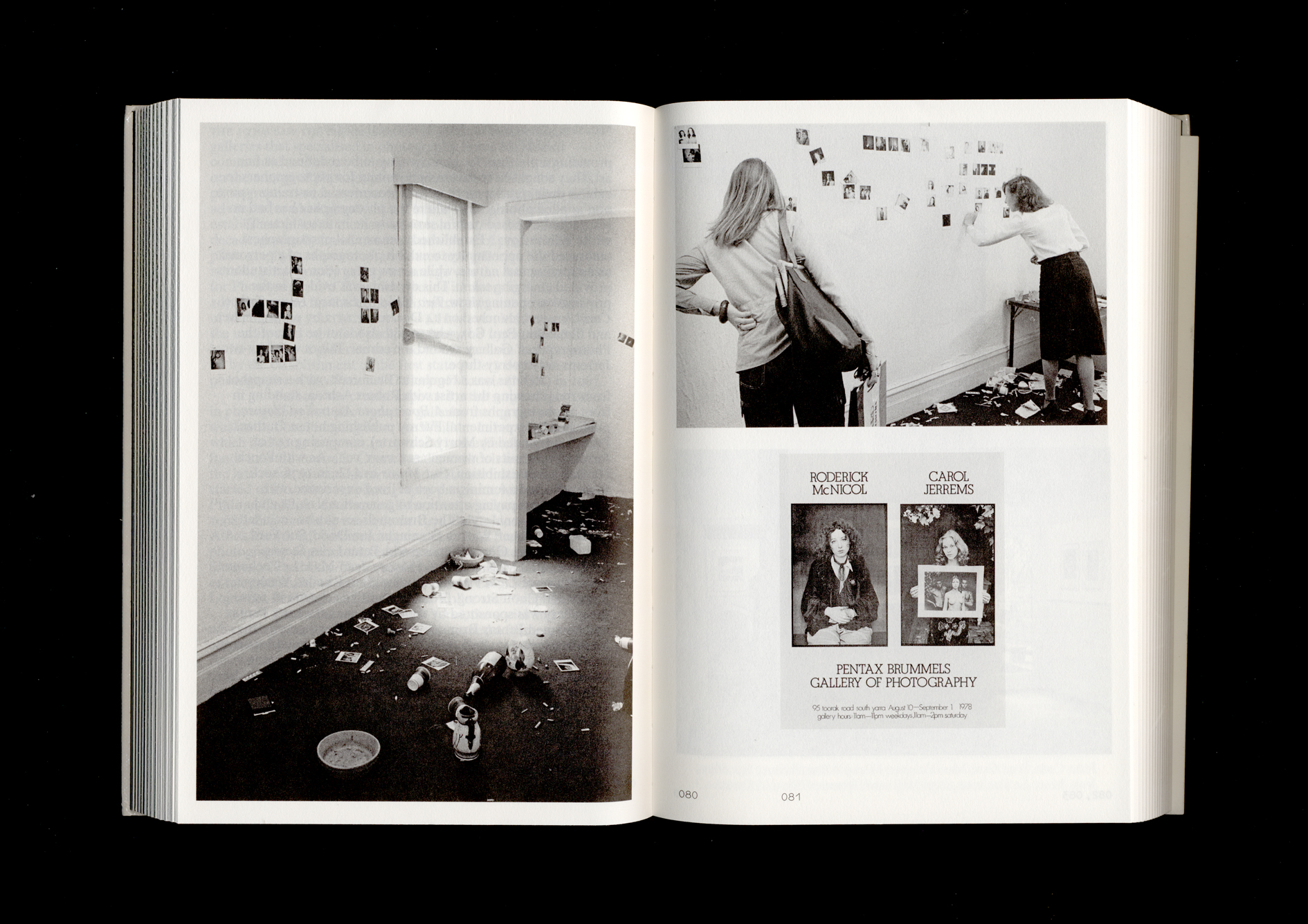
(Installation View, pp. 141–150)
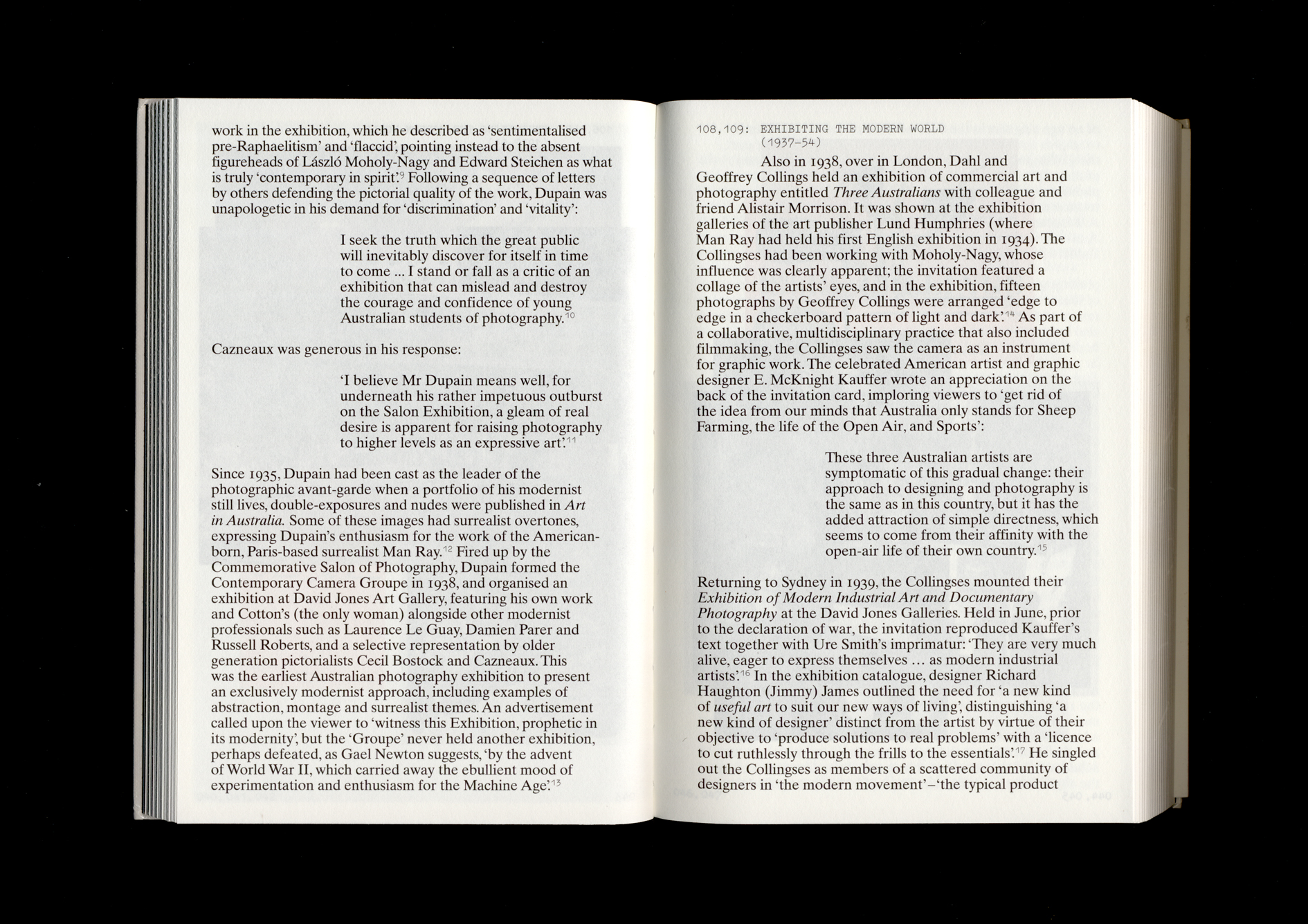
In May 1959, less than two months after The Family of Man was shown in Melbourne, a collective of photographers called Group M held the first of a series of annual exhibitions titled Photovision at the local Museum of Modern Art. The Melbourne gallery, established by John Reed and Georges Mora, was a modest affair funded by subscriptions and the Melbourne City Council, and was originally located in Tavistock Place, a cobblestone lane off Flinders Street. The early Photovision exhibitions took the form of an international ‘creative photography’ competition but in later years entry was restricted to documentary photographers based in Australia.
Group M formed in 1959 as a collective of Melbourne-based amateur photographers including Albert Brown, George Bell, John Bolton, Roy McDonald and John Crook.1 Earnest teachers and industrial chemists inspired by the tradition of social documentary represented by the Farm Security Administration photographers, they saw themselves as distinct from the ‘salon-minded’ pictorialism still prevalent among camera clubs, and advocated the use of ‘straight’ or unmanipulated photography as a means of expression. In the catalogue to the 1959 Photovision they declared, ‘We are certain that the majority of people appreciate philosophical thinking and social comment expressed through photography’. The 1960 Photovision exhibition was opened by fashion photographer Athol Shmith, and John Reed began his foreword to the catalogue with a plea for greater appreciation of ‘the perceptive vision’ of the artist-photographer: ‘It must be admitted that, in the art world, photography in this country has not yet occupied a very high place’. Making reference to photography being ‘bogged down in an academicism’, by which he meant pictorialism, he went on, ‘Nothing, however, can deny the camera its rights as a medium for those who are able to use it with the perceptive vision of the artist, as has already been shown by photographers in Europe and America’.2
Photovision exhibitions and catalogues were designed by Max Forbes, who was already well known in Melbourne for his European-influenced exhibition design. However, the shape of the Group M exhibitions owed their most important debt to The Family of Man.3 Photovision 1961, for instance, included images of various sizes hung at various heights on white brick walls, as well as enlarged images suspended from the ceiling by fishing wire. The exhibition included work by professionals Wolfgang Sievers and Mark Strizic, among others, and the catalogue also describes film and slides, noting that, ‘although audio-visuals are still in their experimental stage, it is obvious that this method of presenting slides offers the greatest possibilities’.4 A newspaper review described the ‘audio-visuals’ – slides projected to a tape-recorded commentary or mood music – as a ‘new art form’.5 Crook is quoted as saying that ‘most photographers are pretty fed up with ordinary slides’ because ‘they don’t give much emotional satisfaction’. The ‘star piece’ was projected each night at 8pm. Entitled 12 Variations for Camera and Guitar, it featured twelve slides of out-of-focus colour nudes, scratched and dyed, while ‘the guitar plays a slight, haunting accompaniment, which helps to create a good feeling’.6 Not everyone was convinced by the exhibitions. For instance, the photographer H. Dacre Stubbs – himself an activist for the establishment of a permanent photography collection in Melbourne, who briefly served with Brown on the National Gallery of Victoria’s (NGV) advisory committee – dismissed Photovision 1962 as ‘just another snapshot exhibition’.7
In August 1963, Group M presented its most ambitious exhibition, Urban Woman, at the Lower Melbourne Town Hall. The exhibition was limited to Group M members and comprised more than two hundred photographs on the theme, mostly candid images by thirteen photographers ranging in age from eighteen to forty-five (the selection was made by Forbes from a much large pool of photographs). The theme was inspired by an observation of the frustrations and loneliness of young mothers in the suburbs, although it included females ranging in age from babies to the elderly, and its stated aim was ‘to confront reality with an unprejudiced eye’.8 The fact that an exhibition of photographs about women were entirely taken by men seems to have gone completely unnoticed. The theme of Urban Woman was conceived as a direct response to The Family of Man, and its exhibition design followed suit, featuring accessible displays of enlarged unframed prints, some measuring up to 150 x 100 centimetres, and including a central wooden structure to display suspended enlargements, and floodlights on stands pointed at the ceiling. However, the only attempt at a narrative chain was their arrangement from youth to old age, which had also been one of the thematic threads of The Family of Man.
Urban Woman attracted significant coverage in the press. One reviewer celebrated the exhibition as ‘a commentary on the life of women in a modern city’ that ‘depicts women, girls and babies in a variety of moods, situations and activities’.9 The fact that no telephoto or flash was used was also pointed out. As photography curator Susan van Wyk has observed, the exhibition also had a broader pedagogical agenda in that it was hoped that the show would encourage others to ‘tackle similar projects, thereby enriching the photographic scene’.10 With the assistance of Gordon Thomson, deputy director at the NGV, Urban Woman was crated and stored in the gallery. From there it was subsequently sent to a number of exhibition venues in Australia, including the Geelong Art Gallery and Launceston’s Queen Victoria Museum and Art Gallery in 1965, and the Perth Town Hall for the February 1966 Festival of Perth. The Department of External Affairs, Canberra, even arranged to have Urban Woman displayed at the Australian Embassy in Mexico during and after the 1968 Olympic Games (the prints returned in 1971 so badly damaged that they were destroyed).11
The sixth Photovision in 1964 included Max Dupain, Wolfgang Sievers, Mark Strizic, Henry Talbot and Richard Woldendorp, and toured to Launceston, Sydney and Adelaide. The exhibition initiated the Eugène Atget award, with the organisers noting in the catalogue that the documentary photographer who had ‘dedicated a lifetime to recording his environment … [and d]ied in poverty’ represented an ‘ideal [that] should be perpetuated’.12 In his introduction, Group M secretary John Crook reiterated that Australian photography had thus far been ‘conquered by the sound disciplines of Pictorialism or Professionalism’ but that both had limited the potential of creative photography (‘There is no doubt that the medium of Photography does not stand high in Australian artistic achievements’).13 Expressing a degree of impatience about the impact of Photovision over the years, Crook nevertheless registered his belief that ‘Photovision has made the start that had to be made for Australian photography to mature’.14 The historian Geoffrey Blainey had also become an advocate, arguing in private correspondence to Brown in 1964 that historians in the twenty-first century ‘would value a systematic collection of photos or film from the 1960s more than say a set of Hansards’.15
In 1965, Group M mounted their final and most critically acclaimed Photovision exhibition, A Time to Love. For this exhibition, four core members – George Bell, Albert Brown, John Crook and Roy McDonald – each presented a series of photographs on a different subject, ranging from aged care and mental health to the aftermath of bushfire and Indigenous communities at Lake Tyers. In the catalogue the photographers argued that ‘these photographs are not the product of inspiration, but lengthy negotiation, observation and patience born of responsibility to the subjects portrayed’.16 A reviewer in the Bulletin agreed that the work had depth owing to its thematic nature: ‘We need much more of photography of this kind and calibre. It should be more widely commissioned, both for the archives and for the education of the community’.17 Brown later sent copies to the University of Texas, which accepted the photographs for its Gernsheim Collection, in return for which one hundred ‘copy negatives’ of family historical pictures in the Gernsheim Collection were sent back to Melbourne – out of which Group M mounted an exhibition at the Argus Gallery (located in the Argus Building on the corner of Latrobe and Elizabeth Streets, the site of the former newspaper) in 1966. After Group M wound down later that year, Brown continued to push his case for ‘purposeful photography’ and was appointed as an honorary photographic consultant to the NGV.
-
The M in Group M is taken from their former name, Moggs Creek Clickers, after the town on the Great Ocean Road where several of the members had holiday houses. Later, professional Sydney photographer Lance Nelson and Perth-based Richard Woldendorp joined the group. See: Philip Bentley, ‘Deeper Feeling, Wider Vision: Group M and the Moggs Creek Clickers’, Master of Arts thesis, Monash University, 1996. ↩
-
Photovision exhibition catalogue, 1960, published by the Museum of Modern Art of Australia, in the collection of the State Library of Victoria, Melbourne. ↩
-
George Bell, Albert Brown and John Crook, ‘The Dark is Light Enough – A concise history of Group M’, April 1994, artist file, held in the State Library of Victoria, Group M: Australian Gallery File, Australian Art and Artists Files Collection. ↩
-
The 1961 exhibition also included photographers from Austria, US, Malaya and Poland, and toured to Paxton Gallery in Sydney in June 1961. ↩
-
‘News of the Day’, The Age, 8 May 1961, p. 2. ↩
-
ibid., p. 2. ↩
-
H. Dacre Stubbs, ‘Stuff at the Museum of Modern Art of Australia’, Professional Photography, June 1962, pp. 24–6. ↩
-
Group M, Urban Woman, exhibition catalogue, Melbourne, 1963. Quoted in Susan van Wyk, ‘Something’s Happening Here… Aspects of Australian Documentary Photography in the 1960s’, in Jennifer Phipps (ed.)., I Had a Dream: Australian Art in the 1960s, National Gallery of Victoria, Melbourne, 1997, p. 80. ↩
-
Patricia Pugh, ‘Urban Woman’, The Sun, Sydney, 21 August 1963, p. 33. ↩
-
Quoted in van Wyk, ‘Something’s Happening Here’, p. 80. ↩
-
Bell, Brown and Crook, ‘The Dark is Light Enough’. ↩
-
Photovision exhibition catalogue, 1964, published by the Museum of Modern Art and Design of Australia, in the collection of the State Library of Victoria, Melbourne. ↩
-
ibid., n.p. ↩
-
ibid., n.p. ↩
-
Quoted in George Bell, Albert Brown, John Crook, ‘The Dark is Light Enough: A Concise History of Group M’, April 1994, in the Group M Australian Gallery File, State Library of Victoria. ↩
-
Photovision ’65 A Time to Love exhibition catalogue, 1965, published by the Museum of Modern Art and Design of Australia, in the collection of the State Library of Victoria, Melbourne. ↩
-
Bill Hannan, ‘Photography without preaching’, Bulletin, Sydney, 23 October 1965, p. 46. ↩