(Installation View), pp. 215–220)
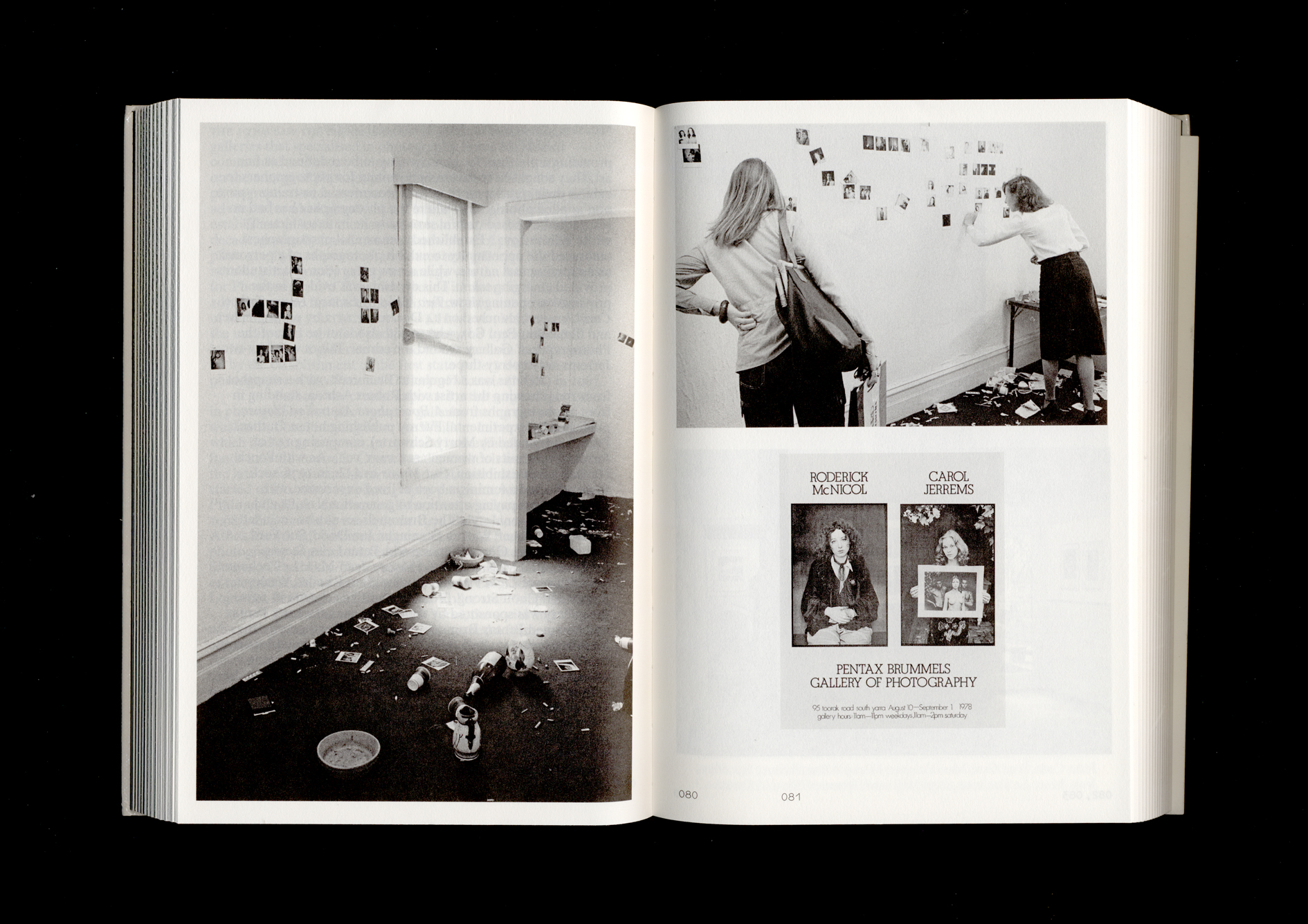
Wesley Stacey’s exhibition, The Road, held at the Australian Centre for Photography (ACP) in 1975, comprised an installation of seventeen horizontal strips of snapshot-sized colour prints, machine printed from tiny 110-sized cartridge film Kodacolor 11 negatives. The strips comprised 280 images taken from the driver’s seat of Stacey’s Kombi van as he drove across Australia between 1973 and 1975. Stacey’s equipment set the work apart – the Kodak Pocket Instamatic 60 Camera had just been introduced to the Australian snapshot market in 1973. The Road was also different from most other photography exhibitions of the time because of the integrated nature of the installation – snapshots from the Kombi window butted together into either long horizontal chronological sequences, such as ‘Marangaroo to the Nullarbor’, or repeated themes, such as ‘Night Roads, Sydney’. The graphic designer Harry Williamson remembers:
At the time, most exhibitions were orchestrated around a sort of folio view of the photographer’s range: interesting portraits, the city, the country, and so on. But here was a close-up, specific point of view sustained over many, many images.1
John Szarkowski, the curator of photography at the Museum of Modern Art in New York, declared Stacey’s work ‘the most radical thing he had seen’ during his visit to Australia, and both the curator of photography at the Art Gallery of New South Wales Gael Newton, and the eminent photographer David Moore, deemed it a landmark work.2 In his review for the Sydney Morning Herald, curator Daniel Thomas praised the ‘technical liberation from the need to think about exposure and focus [that] allows the quickest response to whatever visual stimulus catches the eye’.3 Thomas also noted the ‘Pop Art juxtaposition of the geometric and the brightly coloured’ that resulted in ‘a joyous, spontaneous revelation of the visual gaiety that exists anywhere, if only you have eyes to see it’.4 Indeed, Stacey’s work shared formal traits with the work of pop-inspired conceptual artist Robert Rooney, working in Melbourne at the same time.