(Installation View, pp. 397–402)
From the point of view of the individual photographer, the context for exhibiting photography in Australia in the twenty-first century might seem dominated by the photo prize. Like the pictorialist salons before them, photography prizes are a way for Australian photographers to see their work alongside other photographers – to feel themselves part of a national practice. Prizes for photography appear to have grown in significance as photography galleries continue to close nationwide. The careers of even well-established photographers with museum and gallery exhibition histories benefit from the recognition and exposure of being shortlisted or winning.
The contemporary spate of prizes began in the early 1980s with the short-lived Lady Mary Fairfax Award for photography at the Art Gallery of New South Wales. In 1983, Audray Banfield of the Albury Regional Art Gallery began a biennial photography prize that continues to this day as the Murray Art Museum Albury Biennial National Photography Purchase Award. For the inaugural prize in 1983, Helen Ennis and Gael Newton selected canonic photographers such as Max Dupain, Richard Woldendorp and Phillip Quirk for acquisition, as well as emerging photographers such as Kate Breakey.1 The Muswellbrook Photographic Award began in 1987 and ceased in 2014, while the City of Perth Photomedia Award began in 2004 but only lasted until 2006. The awards that survive include the Josephine Ulrick & Win Schubert Photography Award, which commenced in 2002 at the Home of the Arts (formerly Gold Coast City Art Gallery); the Tweed Regional Gallery’s Olive Cotton Award for Portrait Photography, which began in 2005; Monash Gallery of Art’s William and Winifred Bowness Photography Prize, initiated in 2006; the Moran Contemporary Photographic Prize, first held in 2007; and the National Portrait Gallery’s National Photographic Portrait Prize, which began in 2009. Prize money varies from $10,000 to $50,000, and entry fees are currently up to $100 per print. The economics work out for the institution – some are acquisitional, and all present good sponsorship and public engagement opportunities – but not so well for a serially unsuccessful photographer. Like the pictorialist salons, in order to be selected and hung, photographers must conform to a set of both explicit and implicit rules. Prizes tend to favour the single print over the series, and because they are selected from a large volume of entries, they sometimes favour the meretricious over the meritorious. Prizes are unable to explore any but the most general of themes and, except for the occasionally quixotic judge’s selection, vary little from year to year.
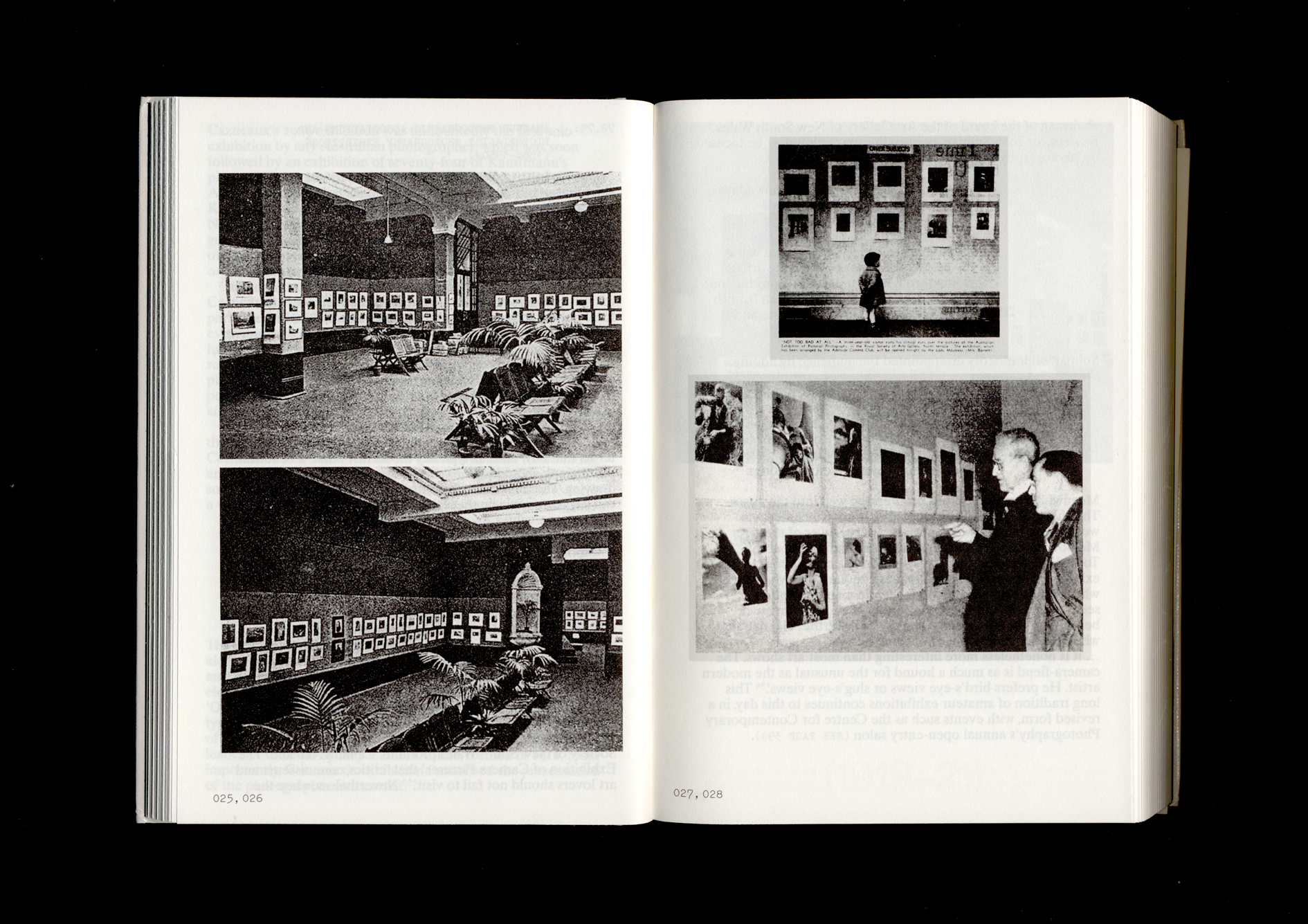
The Centre for Contemporary Photography (CCP) in Melbourne has run an annual summer salon since the 1990s. Originally sponsored by Kodak, then Nikon and more recently by Ilford and a local property developer, the exhibition extends the history of amateur salons, with prizes provided by the photographic industry, but with key differences. The exhibition is as much a fundraiser as a community event, open to everyone who pays the modest entry fee. It features almost exclusively local photographers in contrast to the historically more international salons. Promotion for the 2019 event – which attracted 506 entries, including an entire wall of black-and-white prints, as well as a specially commissioned ‘Instagram wall’ – explicitly articulated the value of viewing prints in a gallery, suggesting that ‘printed work is a much-needed opportunity to slow down’ in contrast to ‘the ever-present digital deluge’ online. Always the best attended exhibition in the CCP calendar, the salon, according to the 2019 catalogue, ‘encourages the social act of visiting a gallery and engaging with images, in real time and real space, with friends, family and colleagues’. Camera clubs, some of which are now over a century old, and more recent online Facebook groups and Instagram hashtags, also continue the social community traditions of photography in Australia.
Like prizes, photography festivals also bring a community of photographers and audiences together, with high-profile international guests, commissions and associated events often included in the program. Western Australia’s biennial FotoFreo, initiated by Bob Hewitt, began in the port city of Fremantle in 2002 and ended in 2012 with Martin Parr as a guest. Sydney’s Head On festival, initiated by Moshe Rosenzveig, began in 2004 as a portrait prize and from 2008 became a wider festival, which continues today. The biennial Queensland Photography Festival was initiated by the Queensland Centre for Photography in 2006 and ran to 2012; and the short-lived Vivid National Photography Festival took place in Canberra in 2008. Jeff Moorfoot initiated the Daylesford Foto Biennale in 2005, which later became the Ballarat International Foto Biennale in 2009. The festival continues under new director Fiona Sweet, and in 2018 found a permanent home at the aspirationally named National Centre for Photography. An ambitious new photography festival, PHOTO, was launched in Melbourne in 2020 under the direction of Elias Redstone.2
Festivals rely on an enormous amount of individual energy, are often precarious, and sometimes do not build enduring professional structures to sustain a wider ongoing practice. Like photography prizes, the individual exhibitions that festivals bring together often vary in style and quality, but they have introduced new professional processes into Australian photography, such as large-scale portfolio viewing sessions, and they continue to create a ‘buzz’ around the idea of photography and the figure of the photographer. Like contemporary art biennales, festival exhibitions often take place in temporary sites such as former industrial buildings and warehouses, and often leak out into the public realm, engaging new communities and audiences.